

Gartner's Agent Autonomy Tiers Demand Network Boundaries
By wGrow Project Team ·
The Decommissioning Warning
Gartner’s sharper warning is that a large share of agentic AI projects won’t survive to 2027 — cost, unclear business value, and inadequate risk controls all sit in the blast radius of that forecast [1.2.2]. This piece is about the governance failure inside it: autonomy frameworks that exist on paper and nowhere else.
Here’s what that actually looks like on the ground. A compliance document labels an agent “Level 1: Observe Only.” Someone signs it, files it, and an auditor cites it a year later during review. Meanwhile the agent’s service account is sitting on network access and database credentials perfectly capable of executing a write command. Nothing in the runtime stops it. The only thing standing between “observe only” and a modified production table is a sentence telling the model not to bother.
That’s not a security model. It’s an honor system wearing a security model’s clothes. Natural language is not a control, and any auditor worth their fee will say so in the first meeting.
Why Auditors Reject Prompt Engineering

I watched this happen almost verbatim during a compliance review for a Singapore SME client. The engineering team’s first pass at the control was a system prompt addition: “Do not modify customer records.” Sounds fine. Reads fine. Worth nothing.
The auditor killed it in the first fifteen minutes — no debate, no back-and-forth. Prompt-level constraints don’t count as access control, full stop. Her reasoning was blunt: a system prompt is a suggestion fed to a probabilistic model, not an enforcement mechanism. Prompt injection defeats it. Model drift defeats it. A careless fine-tune defeats it. And when any of those happen, there’s no log entry, no alert, nothing — the failure is silent by design.
What passed the review looked completely different. We went into the API gateway and explicitly blocked POST, PUT, and DELETE for that agent’s specific API key — at the gateway, not inside the model’s instructions. The agent wasn’t told not to send a mutating request. It physically couldn’t. There was no interpretive gap left between “the agent chose not to” and “the agent was incapable of it.”
That’s what got stamped. Prompt engineering has its place — shaping tone, guiding output, smoothing the user experience. It is not a security boundary, and treating it like one is a fast way onto Gartner’s cancellation list.
Mapping Autonomy Tiers to Hard Boundaries
Gartner’s autonomy tiers work fine as a taxonomy. As a compliance artifact, they’re worthless unless every tier maps to a specific, enforced infrastructure state — something you can point at, not something you can quote.
Level 1 (Observe) should look exactly like an AWS IAM ReadOnlyAccess execution role attached to the agent’s task. Not “the agent is instructed to only read” — the agent’s policy simply has no write actions in it. Try a mutation and IAM returns a 403 before the request ever touches the data store. There’s no retry logic to write, no graceful-degradation path to design. The write just never happens.
Level 2 (Act with Approval) should be enforced through VPC endpoint restrictions paired with AWS Step Functions. The agent can prepare a payload — draft the update, stage the write — but execution stalls at a state machine step that needs a human-issued approval token. There’s no clever path around that pause. It’s not a checkbox sitting in some UI waiting to be clicked; it’s a missing execution permission until the token actually exists.
The test I use is simple: if you can’t point to the IAM policy or network ACL enforcing a given autonomy tier, that tier doesn’t exist. It’s a label on a slide, nothing more.
The WaterDoctor Telemetry Architecture
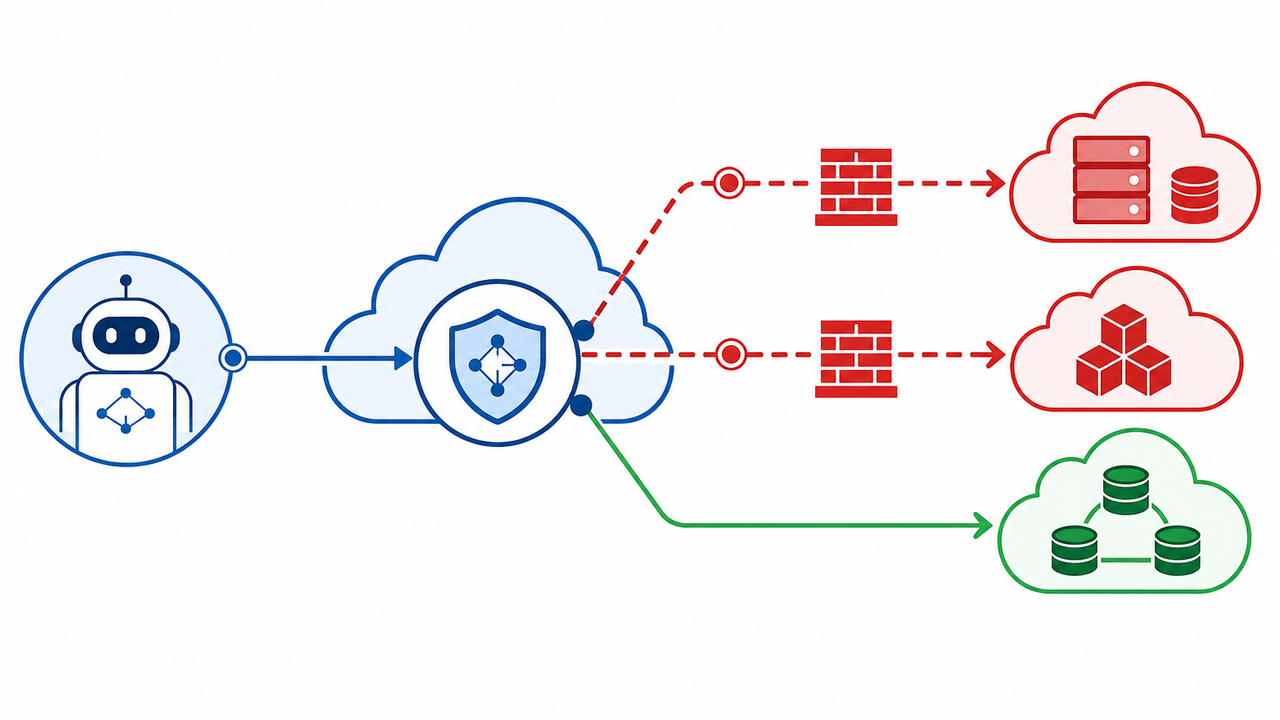
We built exactly this pattern into our AWS deployment for WaterDoctor, where agents read and analyze sensor telemetry streaming in from field water-quality monitors. The job: find patterns in the incoming data, flag anomalies, summarize trends.
We didn’t instruct the agent to leave the raw telemetry table alone — we made that instruction unnecessary. It runs in an isolated subnet reachable only through a read-only endpoint, and the database role bound to its connection carries no write-capable grant at all. No UPDATE. No DELETE. No DROP. The credentials attached to that agent can SELECT against the telemetry store and nothing else, full stop.
This isn’t paranoia for its own sake. LLMs hallucinate, and prompt injection is a live attack surface for anything ingesting external sensor data. So say the model somehow generates a DROP TABLE command — corrupted input, an injection buried in a malformed sensor payload, a plain reasoning failure, doesn’t matter which. The architecture doesn’t care about the cause. That statement has nowhere authorized to land: the network path only exposes the read endpoint, and the database role has no DROP privilege to invoke even if the connection reached the table. The statement fails whether or not the model “meant” to send the command. Intent is irrelevant when the underlying grant was never issued in the first place.
Dropping Packets as Governance
Stop trying to govern LLMs with natural language. It won’t survive an audit, and it definitely won’t survive an attacker who’s read the same prompt-injection research everyone else has.
Treat AI agents like untrusted third-party vendor APIs, because functionally, that’s what they are. Define autonomy at the API gateway and the IAM layer — allowed methods, allowed resources, allowed network paths. Everything else is documentation. Fine for onboarding new hires. Useless for enforcement.
None of this is free, to be clear. Standing up gateway-level and IAM-level controls for every autonomy tier takes real engineering time — more than typing a new line into a system prompt — and it only solves one category of problem: unauthorized actions. An agent with legitimate write access can still write garbage data. IAM won’t catch that; application-level validation and monitoring have to carry that weight instead. But that’s a narrower, more tractable problem than the one Gartner is actually describing — agents doing things nobody authorized to begin with. Infrastructure controls close that specific gap regardless of what the model thinks it’s doing.
The failures Gartner is warning about for 2027 will hit hardest where agent autonomy is governed by policy memos instead of enforceable controls. Hard boundaries won’t rescue a weak product, a bad workflow, or a business case that never made sense — those failures happen with or without a well-scoped IAM policy. What they will do is close one specific, audit-killing gap: an agent doing something the infrastructure never gave it permission to do in the first place.