

Agents That Pay Need Payment Limits, Not Vibes
By wGrow Project Team ·
AWS’s Bedrock AgentCore Payments preview puts payment execution inside the agent workflow, with Stripe and Coinbase listed as supported providers [S1]. We are handing large language models the company credit card. The architecture required to manage that safely has nothing to do with prompt engineering — it has everything to do with double-entry accounting, velocity caps, and the tiered purchase-order logic that SME ERP systems were already solving in 2014.
The Hallucinated Treasury Drain
Bedrock agents can now trigger external payment APIs to settle invoices or purchase digital goods using stablecoins. The execution path itself is not complex — constructing a Stripe API payload and firing it is a few dozen lines of code. The engineering challenge is the failure surface.
In early internal testing with our agentic crews, an LLM entered an infinite retry loop because it misread a standard 402 Payment Required JSON error as a transient network fault and kept resubmitting. In a sandbox, that produced a comical log file. Apply the same logic to a live payment gateway, and a 50,000 outflow from a misread HTTP status code.
The rule that follows is blunt: autonomy requires hard limits built outside the LLM environment. The model cannot be the final arbiter of whether a payment executes, nor can it be the circuit breaker. It is the clerk that drafts the voucher, not the controller that signs it.
System Prompts Are Not Financial Controls

Natural language instructions cannot constrain spending behaviour under real operational conditions. A prompt that says “do not spend more than $500 per transaction” is a polite request. A database constraint that rejects any outbound payload with amount > 500 is a policy. These are not equivalent, and treating them as equivalent is how a ledger anomaly becomes a conversation with your CFO at 11 p.m.
The distinction matters because LLM instruction-following is probabilistic and context-sensitive. Under a normal prompt, the model may honour the $500 ceiling. Under a sufficiently unusual input — a complex multi-step reasoning chain, a confusing vendor response, a token-length pressure situation — it may not. Financial controls cannot rely on probabilistic compliance.
We ran tiered purchase-order authorisation workflows for SME clients in 2014. The logic was simple: a junior clerk could raise a PO up to 100 and 500 triggered a second state change requiring director-level sign-off. The clerk never had direct access to the payment output. The state machine controlled the release.
Port this logic to Bedrock unchanged. The agent is the junior clerk. It drafts the intent, constructs the payload, and halts. A separate, hard-coded approval service evaluates the payload against budget limits and vendor whitelists. The agent reaches Stripe only if that service returns a signed token. The LLM never touches the signing key.
Reversible and Irreversible Tasks
Agent tasks divide into two categories by cost of failure. Drafting a purchase summary is reversible — edit it, discard it, redo it at zero cost. Transferring USDC to a vendor address is not. It cannot be undone by editing a prompt. The architecture has to reflect this asymmetry.
For WaterDoctor, we built an automated quotation engine that calculated complex pump configurations and issued customer-facing quotes without human review on standard replacement jobs. It was efficient and accurate on familiar configurations. For anomalous ones, we built a mandatory halt state: if a quote configuration fell outside pre-defined equipment pairings, or if the calculated price deviated more than 15% from the three-month rolling average for that job class, the system queued the quote for an engineer’s manual override before it reached the client.
A bad pump quote costs margin. An agent paying a hallucinated vendor costs cash. The threshold logic is the same; the stakes are not.
Apply the WaterDoctor model to Bedrock AgentCore: agents operate within a narrow, pre-defined confidence band. Any transaction outside the approved vendor list, the expected amount range, or normal frequency for that workflow class routes to a human controller before execution. Defining that band requires upfront calibration — and ongoing adjustment as vendor and pricing patterns shift.
Settlement Speed Against Ledger Reconciliation
Set aside the stablecoin framing for a moment. The operationally useful properties here are instant settlement and programmable transfer flows — both of which apply equally to fiat payment APIs. But instant settlement does not eliminate the reconciliation requirement. It compresses the window in which errors can be caught before a payment clears, which makes upstream controls more important, not less.
The reconciliation problem is structural. An enterprise running Bedrock agents across multiple workflows will generate transactions from distinct agent wallet IDs. Each wallet ID must map to a cost centre, a general ledger account code, and a vendor record. Every transaction must tie back to that structure. Without that mapping, you end up with a blockchain transaction log and a P&L carrying an unreconciled variance — a different kind of problem, but not a smaller one.
Refund and chargeback paths deserve the same design attention as the payment path. The scenario where an agent purchases API credits for the wrong workflow requires a pre-execution block and a post-failure recovery runbook — not a Slack message to the ops team. For stablecoin transfers, no reversal path exists once the transaction fires; the only control that holds is one enforced before execution. If the chargeback path is a human filing a support ticket, the system is not production-ready.
Architecting the Agentic Purchasing Workflow
| 1 | { | |
| 2 | "agent_id": "ag_9f82b", | |
| 3 | "wallet_id": "wal_prep_001", | ← ① |
| 4 | "max_daily_tx": 5, | ← ② |
| 5 | "max_amount_usd": 500.00, | ← ③ |
| 6 | "approved_vendors": [ | |
| 7 | "vd_stripe", | |
| 8 | "vd_aws" | |
| 9 | ] | |
| 10 | } |
- ① Pre-funded, isolated wallet ID
- ② Daily transaction velocity cap
- ③ Absolute dollar ceiling
The technical stack for managing this is not long. But each component is load-bearing.
Velocity caps at the database layer. An agent wallet must be constrained to a maximum transaction count and a hard dollar ceiling per 24-hour window, enforced in the database schema before any API call is constructed — not in the agent, not in the prompt.
Isolated agent wallets. Never connect a primary corporate treasury account to an autonomous agent. Fund agent wallets like prepaid cards — load a specific allocation for a specific workflow, with no automatic top-up. When the allocation is exhausted, the agent halts and alerts. This limits blast radius to the loaded balance.
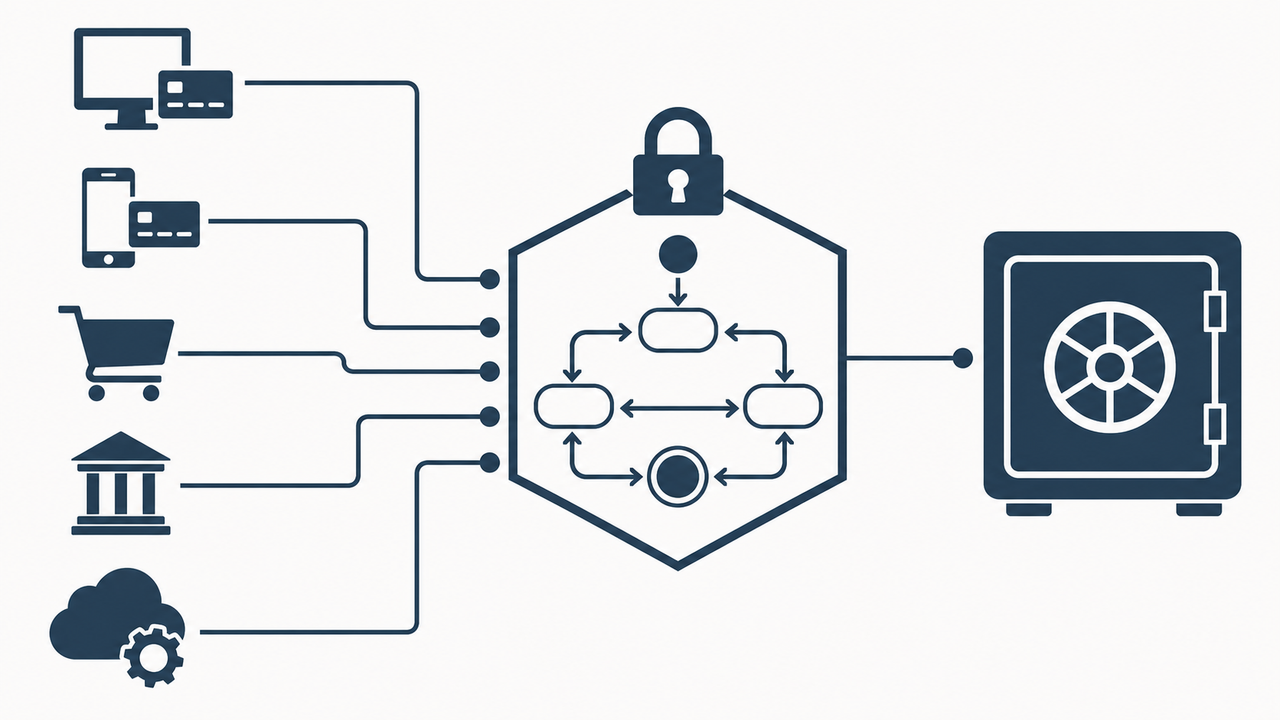
Deterministic approval state machines. The LLM processes the intent and drafts the payload. A separate service — no ML, no inference — evaluates the payload against budget limits, vendor whitelists, and frequency rules. This service is auditable, version-controlled, and testable with unit tests. It either returns a signed execution token or it does not. The agent calls the payment API only if the token is present.
Reconciliation hooks at transaction creation. Every outbound payment writes a ledger entry to your accounting system at the moment it is queued, not after it clears. If the payment fails, the entry is reversed deterministically. If it clears, it matches to the vendor invoice record. The transaction hash becomes the reconciliation reference.
Where This Lands
The enterprise value of agent-initiated payments is real. Automated procurement, real-time vendor settlements, programmable payment flows across complex supply chains — these are genuinely useful capabilities. None of that value is accessible if financial controllers cannot sign off on the risk model.
Financial controllers adopt systems with hard limits, auditable approval chains, and complete reconciliation coverage. Not systems that depend on model compliance. Wrapping Bedrock AgentCore inside proven ERP approval logic reduces the probabilistic risk to a narrow execution band that a database can enforce and a human can review.
Once the caps are hard-coded and the approval state machine is in place, agentic procurement becomes operationally unremarkable. The agent raises the PO. The state machine approves it. The ledger closes clean.
Boring is exactly what enterprise finance requires.